
Webinar on Ayamel

I had a great time yesterday doing a webinar on Ayamel. I have given many presentations in many different settings, but this was perhaps the most challenging. Sitting there looking at the computer screen with no visual feedback from the audience was interesting, to say the least.

As I was speaking during the presentation, I noticed a couple of typos in some slides due to some late additions. Also, listening to it afterwards, I noticed way too many “uhs,”which I considered editing out. Now, however, I have decided to throw vanity to the wind and make the link available immediately, simply because I believe that the brilliance of Ayamel will come through, despite the imperfections in the presenter’s delivery!

With that explanation, here is the link on YouTube for the video of the webinar. I have posted the PowerPoint deck here (corrected of course! 🙂  ). All I ask is that anyone who downloads the deck give attribution, should any slides be used in another presentation.
Posted in Interactive Video, Online Learning | Leave a comment

Moving Forward with Online Learning?

I have heard rumblings that BYU Provo that BYU Provo is showing an increased interest in online learning.

I will confess to mixed feelings, however, which I will admit are totally selfish…

Shortly after I arrived at BYU in 1992, I visited with the late Dwight Laws, the manager of BYU Independent Study at the time. The thrust of the interaction was a discussion of the work I had been doing with the technologies of the day at the Air Force Academy. His response was that they were totally open to doing creative stuff, as long as it could be delivered with paper and ink.

In all fairness to Dwight, it is only now, inLLC2 the 15th year of the new century that we can do on a wide scale the sort of things we were doing in 1992 at the Air Force Academy. Even then, what we did was on a very limited scale. A primary

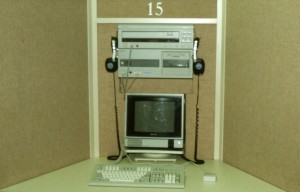
limiting factor of course was the expensive nature of the technologies of the day: The price of each Sony View 3000 videodisc workstation was $8,000, which would be at least $12,000 today. Even then, the limited number of workstations required that we assign two students to each workstation at a time, which explains the two headsets and one mouse seen in the photo. So much for individualized learning.

The primary irritating factor today is my advanced age, which will limit my involvement in a very exciting time for learning: If the technology can do something useful for teaching and learning, don’t waste the teacher’s time doing those things. We know that there are many exciting, interesting, and motivating things the teacher can do that the technology will not, for the foreseeable future be able to accomplish (Star Wars’ C-3PO not withstanding!)

A second irritating factor is that online learning efforts are not yet fully exploiting the tremendous computing power people are carrying around in their pocket.

Perhaps that is about to change?


Posted in Online Learning | Leave a comment

Educational Technology Bust

It seems that Apple and Pearson are about to shell out big bucks, $6.4 million to be exact for ipadwhat appears to be a massive failure in supporting a tablet initiative in a thousand schools in Los Angeles:

The Los Angeles Unified School District has reached a tentative $6.4-million settlement over curriculum from education software giant Pearson that the school system said its teachers barely used.

The pact is the latest fallout from an aborted $1.3-billion plan to provide an iPad to every student, teacher and campus administrator in the nation’s second-largest school district.

The Board of Education is expected to vote on the settlement in October. The bidding process that led to the original contract is the subject of an FBI investigation.

This is from a piece in the Los Angeles TimesLA Unified to get $6.4 million in settlement over iPad software, that says that an FBI investigation is underway into the manner in which the contract was let. The writer also quotes an attorney for the school district, “one goal is to make sure schools are ready to use technology before they receive it.” Well duh!

I often say that forecasting technology applications is really tough, especially when it involves the future. We also know that we will be wrong twice… We will overestimate the near term and underestimate the long term. Although Pearson claims that their materials are being used effectively in many other schools, it seems that in this case these folks are in the near term of effective uses of tablet devices.

Read more here and here.

Posted in Online Learning | 2 Comments

Storytelling and Education

I have believed for some time that good educational practice is intimately related to the notion of good storytelling. As I was reading today about this massive investment that Facebook founder, Mark Zuckerberg, and other tech leaders are making in education through “Altschool,” I was surprised by the connection that I quickly made between that investment in those schools and storytelling. The connection came from a passage in that piece that described the schools as implementing individualized learning, a “Reggio Emilia-Approach Intertwined With Technology.” Knowing nothing about Reggio Emilia caused me to jump to this Wikipedia article on the schools in Reggia Emilia, Italy. Here is the quote from that piece that caught my attention:

 For example, teachers in Reggio Emilia assert the importance of being confused as a contributor to learning; thus a major teaching strategy is purposely to allow mistakes to happen, or to begin a project with no clear sense of where it might end.

It seems that the idea of being confused, allowing mistakes to happen, or having no clear sense of how a project is to end is tantamount to the essence of good story telling, no?

Posted in Online Learning | Leave a comment