AI for Converting Handwriting to Digital Text

ChatGPT became publicly available on 30 November 2023, and my software-engineer grandson mentioned it to me a few days later. Ever since, I have been amazed over and over at the power of these incredible AI tools that have become available. During the ensuing months, I have shifted from ChatGPT from OpenAI, to Claude from Anthropic, to Grok from xAI, moving over time from one to the other and back again.

I first subscribed to ChatGPT, which I later cancelled for my move to Claude. I have now cancelled that subscription to move to SimTheory (https://simtheory.ai/). The switch was prompted by being able with this service to gain access to many of the models available today through several sites. (I have listed those here.) I also still use several of the popular models directly in the “free” mode, often reaching the limit available to that tier. These include Gemini from Google and Copilot from Microsoft, and Gemini seems to be leading the pack at the moment.

I make extensive use of these various tools to support the software development I do for the service mission in which I am engaged for my church (The Church of Jesus Christ of Latter-day Saints). I have not settled on one particular model, and the progress I have seen over the past two-plus years has been incredible. It is amazing to see how much more is possible now than at the beginning. Since the beginning, all the major systems have added capabilities like the submission of screenshots, several code files, and an interactive process that is totally amazing.

My 56 years of programming experience is obviously important and has enabled me to learn how to put these tools to work. At this point it is an understatement to say that I am able to function at a level of software engineering that is FAR BEYOND what I would be able to do on my own. While the progress I have seen has been enormous, it has also been gradual, albeit rapid. With that, the leap forward I have seen today has been nothing if not incredibly astounding!

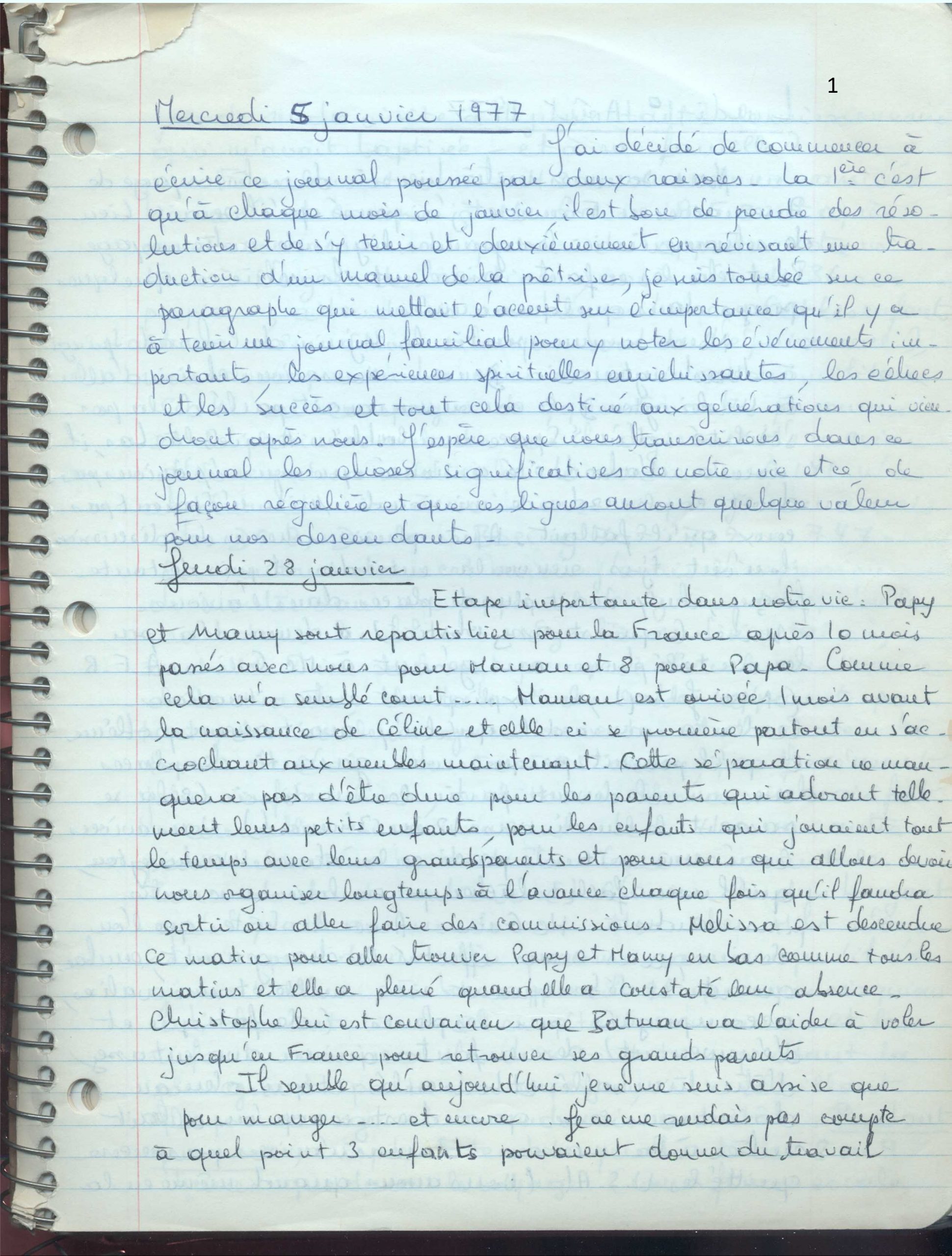
Indeed, this example is mind boggling, to say the least. Rather than being an experience related to programming, however, this development is in the area of handwriting recognition. This effort started also in 2023 with family records and journals. I use OCR on Adobe Acrobat Pro for scanned typed and printed documents. For handwriting, however, something else was needed. I discovered Transkribus, described by Wikipedia as “a platform for the text recognition, image analysis and structure recognition of historical documents” (See https://www.transkribus.org/). That system is amazing, but it requires the scanning and training with at least 50 pages of text.

About that same time, I was using Claude and tried it for handwriting recognition with a journal my wife, Annie, kept from 1977 to 1989. Filled with many stories of our experiences and adventures with our family, this is a veritable treasure that we want to share with our children and grandchildren. She is French, so it is written in French, in her beautiful script that takes some getting used to. Here is a page:
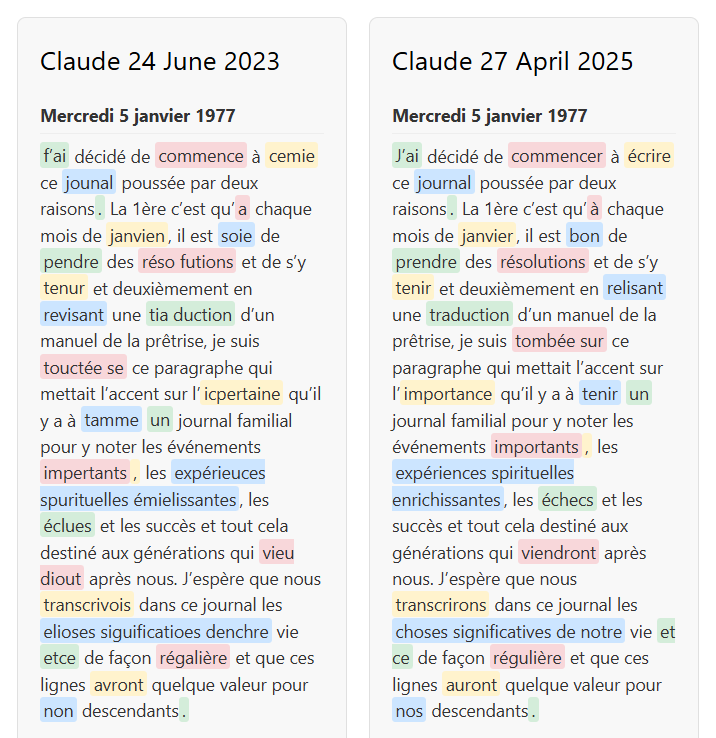
What has totally blown me away today, is the comparison that I just discovered between what Claude (and the others I tried as well!) produced in June of 2023 and what it created today. To show this to Annie, I created a side-by-side Word document to show to her. Needless to say, she was impressed. Indeed, she reviewed and corrected the Word document of the three full pages from her journal and found only 6 corrections that needed to be made in the 847 words from the three pages.

When I thought about posting something about this amazing development, I remembered that not everyone reads French. To address that issue, I came with the idea of using AI to create a side-by-side version how the ability to recognize handwritten text has improved significantly. I wanted to use colors to create a display for the comparison of the 2023 version and the one from today.

To do that, I submitted the Word document to AI, specifically this time to Gemini 2.5 Pro from Google. BTW, many experts are raving about this most recent effort from Google, which so far I am finding quite impressive. Gemini helped me come up with the comparison I wanted by providing the code to display the results on a page here in WordPress.

I will write later about that process in a more detailed post, but the full comparison of these first three journal pages is available at this link. In the meantime, here is an excerpt from the first page from that comparison:
Posted in Geeky Stuff, Generative AI, Large Language Models | Tagged , | Leave a comment

Was the FBI Russia collusion probe a symptom of the intelligence state as outlined by Mike Benz?

The recent release of the FBI files on Russia collusion caught my attention yesterday. Along with many others, now-independent, Emmy-winning investigative journalist Catherine Herridge is reporting on the story:

Herridge has proven to be more than reliable during her career at ABC News, Fox News, and recently at CBS News. She was laid off from CBS supposedly due to budget cuts, but some say it was because her reporting was a serious bother to too many people.

This story got me thinking about Mike Benz, whose work came to my attention a year ago with an interview he did with Tucker Calson. Since then, he has been interviewed by well-known podcaster/journalist folks such as Joe Rogan, Caroline Glick, and Shawn Ryan. He also gave a presentation at Hillsdale College last September.

He has had that pinned to his feed on X for some time now, and I finally got around to listening to most of it yesterday while walking the dog. It seems important enough now that I am planning to watch so I can see his slides.

RealClearPolitics has posted the X-based video of the interview along with the timeline and transcript:

1:19: The Inauguration of Organized Political Warfare
11:20: NSC 10/2 and the Plausible Deniability Doctrine
15:08: Diplomacy Thru Duplicity
16:04: Smith-Mundt Act, The CIA Media Empire
19:40: The Department of Dirty Tricks
20:36: The CIA As Servant Of The State Department
23:02: 1789-1948 pre-history
29:54: 1948-1983

The whole piece really is worth watching. For anyone short on time, I gave the entire transcript to Grok from xAI with the request for a summary. Here is what it provided:

Mike Benz’s presentation at Hillsdale College outlines the concept of the “intelligence state,” where intelligence agencies, originally meant to serve the state, have overtaken it, operating with significant autonomy and influence. He traces its origins to 1948, a pivotal year marked by the establishment of the CIA and George Kennan’s memo, “The Inauguration of Organized Political Warfare.” This memo, declassified in 2005, followed the CIA’s first major operation—rigging Italy’s 1948 election to favor a U.S.-backed candidate over a Soviet-supported one. The operation involved $250 million in covert funding, propaganda through media like Voice of America, and alliances with churches, charities, and even the mafia, turning these entities into instruments of statecraft.

Benz highlights how Kennan’s vision, formalized in National Security Council Memo 10/2, authorized covert operations like propaganda, sabotage, and subversion, with “plausible deniability” as a core principle. This allowed the U.S. government to deny responsibility for illegal activities, fostering an “empire of lies” both abroad and domestically. The 1948 Smith-Mundt Act initially restricted propaganda within the U.S., but its 2013 amendment allowed government-made news to reach American audiences, weakening safeguards.

The CIA expanded its influence globally, orchestrating 85 regime changes post-Italy, with 50 during the Eisenhower era. By the 1960s, domestic operations like COINTELPRO and Operation Chaos targeted leftist movements, mirroring current efforts against populism. Scandals in the 1970s led to the Church Committee, exposing CIA abuses like assassination tools and media manipulation, prompting temporary reforms under Jimmy Carter. However, Ronald Reagan’s administration restored CIA powers, notably through the National Endowment for Democracy, embedding intelligence operations in NGOs, media, and cultural institutions.

Benz argues the intelligence state isn’t rogue but serves the State Department and Pentagon, executing their agendas while maintaining deniability. He compares it to a mafia structure, with the CIA as enforcers for diplomatic and defense elites. Today, this “blob” counters domestic populism, repurposing Cold War tactics to control narratives and suppress dissent, creating a tension between the American homeland and the global empire’s interests.

So, what are the chances the FBI Russia collusion probe was a symptom of the intelligence state as outlined by Mike Benz? When taken with other things that have happened and are happening, the chances seem to be increasingly high.

Posted in Current Events, Generative AI | Tagged , , , , , | Leave a comment

Malicious Compliance

A friend recently posted his objection on Facebook to the fact that the US Naval Academy had removed 381 books from its library. The comments on the post were quite interesting, and the wide spectrum of opinions expressed made me want to learn more. Reports from various news sources confirmed that books had in fact been removed. Less certain was the precise source of the order to remove the books.

The removal was supposedly done in response to directives received from the Department of Defense. According to reports, the goal of these directives was for all units and agencies to review all training materials and remove instruction on topics related to “diversity, equity, and inclusion” (DEI). I quickly came across what appears to be the actual directive on a DoD Web site.

This document was sent with the subject line “Digital Content Refresh” and contained the sentence, “Components must take all practicable steps, consistent with records management requirements, to remove all DoD news and feature articles, photos, and videos that promote Diversity, Equity, and Inclusion (DEI).” The directive refers to Web sites, but it does not mention library books,. This left the development at Annapolis an open question.

Additional searching did not uncover any evidence that library books had been removed at the US Military Academy or at the US Air Force Academy. With this discovery at Annapolis was nothing more than a case of malicious compliance that was designed to embarrass the current administration.

This is not the first time this has happened this year within the Department of Defense. In January, at least one Air Force unit removed instructional units about the World War II service of the famed Tuskegee Airman and the WASPs. Those events are described in this article in the Air and Space Forces Magazine.

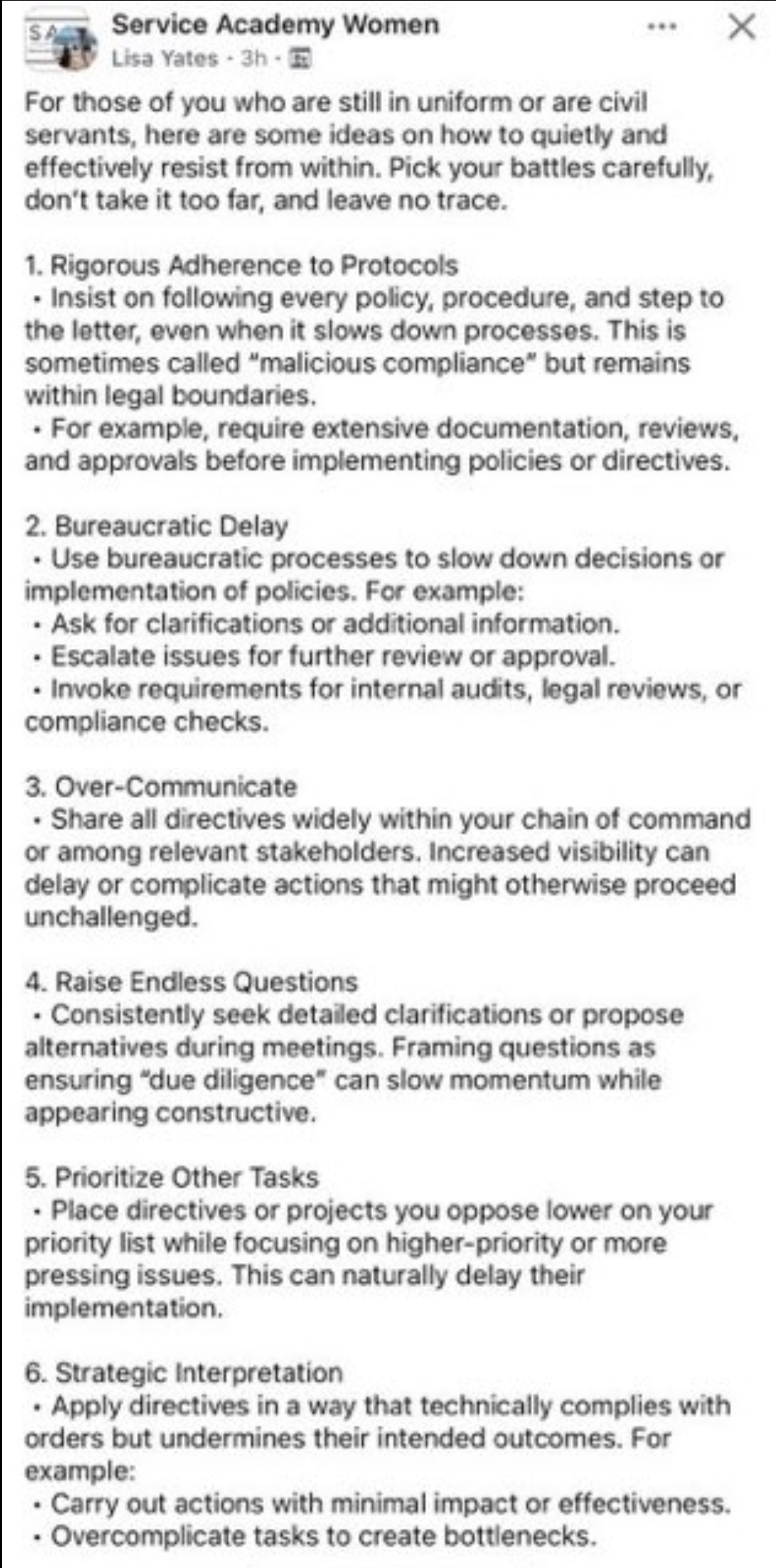
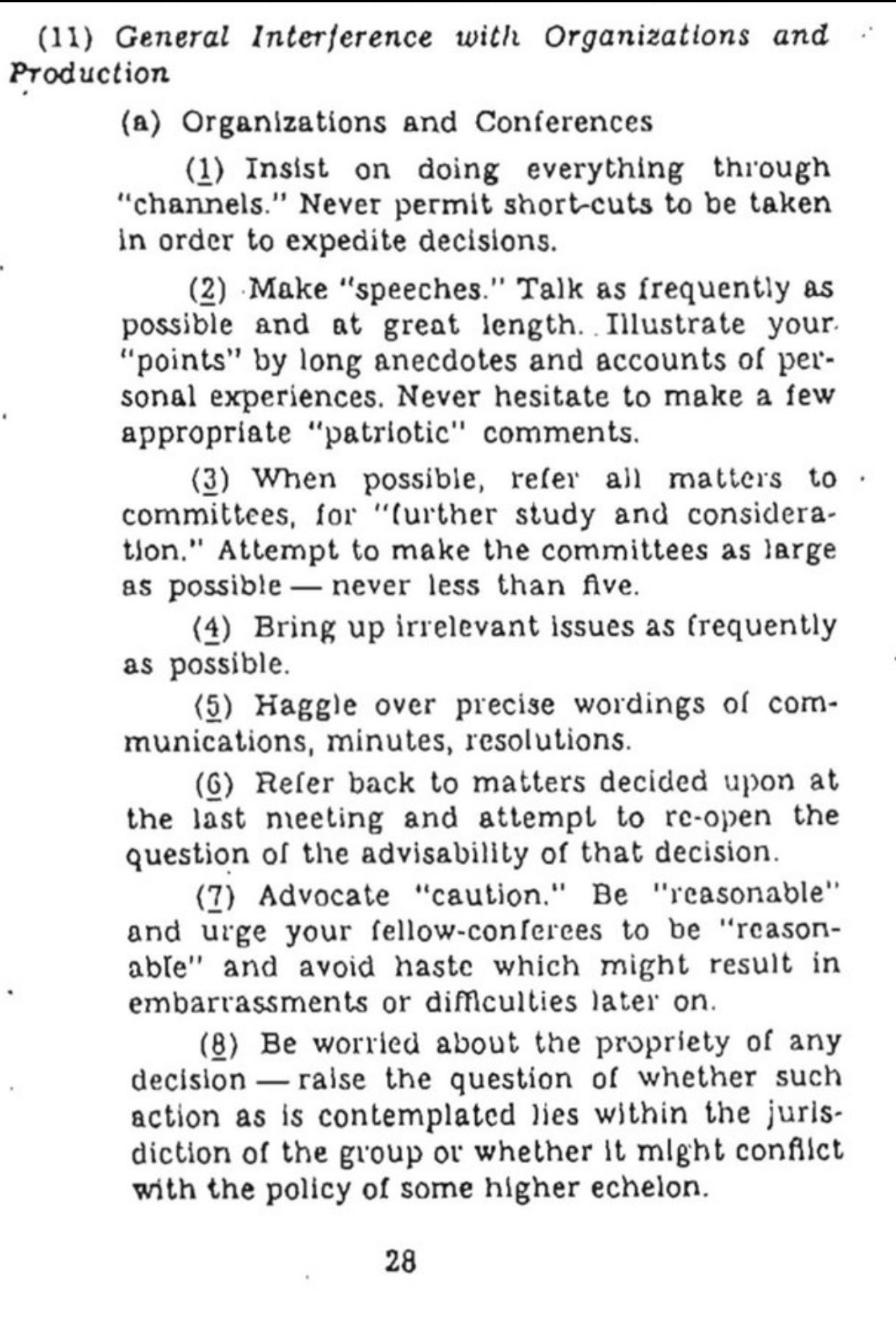
About the time that these events were occurring, I came across a post on social media that was supposedly from a female former Army intelligence officer. She addressed “Service Academy Women” and gave them tips on how to “resist.” In addition, I found a reference to an older document from which this social media post might have been taken. Here are the two documents:

Wondering about the potential source of the older document, I submitted a query to three generative AI systems (Grok from xAI, Claude 3.7 from Anthropic, and Google’s Gemini 2.5 Pro. Grok suggested the excerpt might be from “The Screwtape Letters by C.S. Lewis, a 1942 satirical novel.” Claude and Gemini both concluded that the document was likely “an excerpt from the OSS Simple Sabotage Field Manual from 1944, specifically section (11a) “Organizations and Conferences.” Gemini provided this summary:

In essence, the second image adapts and repackages WWII-era sabotage techniques, originally intended for use against enemy organizations, as methods for internal resistance within modern military or government structures. The core methods of using bureaucracy, procedure, and communication to obstruct and delay remain the same, just presented in a contemporary context with updated language.

The purpose of malicious compliance such as this is to generate negative views towards the current administration. Seeing that the comments on your post range from very positive to very negative, it is safe to say that this effort to foment dissension was successful. The endeavor was aided as per usual by mainstream media such as the New York Times, the source of the article that my friend posted. Unfortunately, it seems these types of occurrences are par for the course in the Age of Trump.

Posted in Current Events, Generative AI | Tagged , , , | Leave a comment

Alma and the Sons of Mosiah

For many years now, a few friends and I have helped organize get-togethers for missionaries who served French-speaking missions for The Church of Jesus Christ of Latter-day Saints. We often refer to these as “reunions,” which they are, of sorts. With the passing years, however, they have become as much about meeting others from other mission periods and even other mission locations than about seeing people with whom we served. Above all, they are about reconnecting with our service, for some that was many years ago, but for some it was more recent.

Last evening (26 March 2025) we were blessed with such an event with Elder Neil L. Andersen of the Quorum of the Twelve Apostles of the Church and Presiding Bishop Gérald Caussé. In his talk, Bishop Caussé spoke of Alma from the Book of Mormon and the chance reunion he had with his former missionary companions, the Sons of Mosiah. The idea of describing that as Alma’s reunion with missionary buddies touched me.

In the service mission work in which I am engaged, I use generative AI quite a bit to help me program at a skill level far beyond my current expertise. In that context I was curious about how Grok xAI would describe that occasion. Note how very little context I provided in the prompt, the results of which I find nothing short of amazing.

“Alma’s Joyful Reunion with Sons of Mosiah.”

By Grok from Elon Musk’s xAI

Prompt: Tell me about the experience Alma had when he reconnected with his missionary buddies, the Sons of Mosiah.

Alma’s reunion with the Sons of Mosiah is a deeply moving moment recorded in the Book of Mormon, specifically in Alma 17. This encounter took place as Alma was traveling from the land of Gideon southward toward the land of Manti. Unexpectedly, he crossed paths with the Sons of Mosiah—Ammon, Aaron, Omner, and Himni—who were journeying toward Zarahemla. The meeting was a surprise to Alma, and his reaction was one of overwhelming joy.

The context makes this reunion particularly significant. Years earlier, Alma and the Sons of Mosiah had been companions in rebellion, actively working to undermine the church of God. Their dramatic conversion came when an angel appeared to them, calling them to repentance (Mosiah 27). This shared experience forged a bond between them, but their paths diverged afterward. While Alma stayed among the Nephites, serving as a prophet and leader, the Sons of Mosiah chose to embark on a challenging mission to preach to the Lamanites, a people often hostile to the Nephites. They had been gone for 14 years by the time of this reunion, and Alma had no recent knowledge of their fate.

When Alma saw them, his joy stemmed not just from seeing old friends but from discovering that they were “still his brethren in the Lord.” Despite the long separation and the hardships they had faced, the Sons of Mosiah had remained faithful. They had grown strong in their knowledge of the truth, having diligently studied the scriptures and devoted themselves to prayer and fasting. This spiritual growth equipped them with the spirit of prophecy and revelation, enabling them to teach with power and authority. Over their 14-year mission, they had successfully brought many Lamanites to a knowledge of the truth, a remarkable achievement given the difficulties of their task.

The reunion was more than a personal moment; it marked a convergence of their missionary efforts. The Sons of Mosiah were returning with a group of Lamanite converts, the Anti-Nephi-Lehies, seeking refuge among the Nephites. Alma, who had been working to strengthen the church in Zarahemla, played a key role in facilitating their acceptance. Later, in Alma 27, when they met again after these events, the joy was even more profound. Ammon, overcome with emotion, collapsed from exhaustion, and Alma and the others rejoiced greatly.

This encounter highlights the strength of their shared faith and the power of their individual journeys. Alma’s astonishment and happiness reflect the unexpected blessing of seeing his former companions not only alive but thriving in their devotion, a testament to their enduring brotherhood and commitment to their divine purpose.

Posted in Generative AI, Large Language Models | Tagged , , | Leave a comment